


Publishing a book can take a few months or well over a year. The difference is not just speed. It is the amount of work between the current manuscript and the finished book.
A clean, revised manuscript with simple print and eBook editions can move through production faster than a long draft that needs structural editing. An illustrated book, workbook, index, or fixed event date adds more dependencies.
The most reliable timeline starts with a manuscript review. It then gives each stage enough time for the work, author feedback, corrections, and proofing. Platform review happens near the end. It should never be confused with the full publishing process.
The Short Answer
For an independent book, plan the schedule around these stages:
- Manuscript assessment and editing.
- Final proofreading before layout.
- Cover and interior design.
- Print and eBook file preparation.
- Metadata and account setup.
- Digital preview and physical proof.
- Corrections and final approval.
- Platform review and release.
- Launch preparation.
Some work can overlap. Other work must wait. The final print cover, for example, needs the approved trim, paper choice, and page count. A page index needs the stable print layout. A public launch should wait until the final files pass review.
Need a Timeline Based on Your Manuscript?
Share the book’s stage, word count, formats, and target release date. Liberty can help you identify the work that must happen before publication.
Request a Publishing Timeline ReviewStart With the Manuscript’s Real Condition
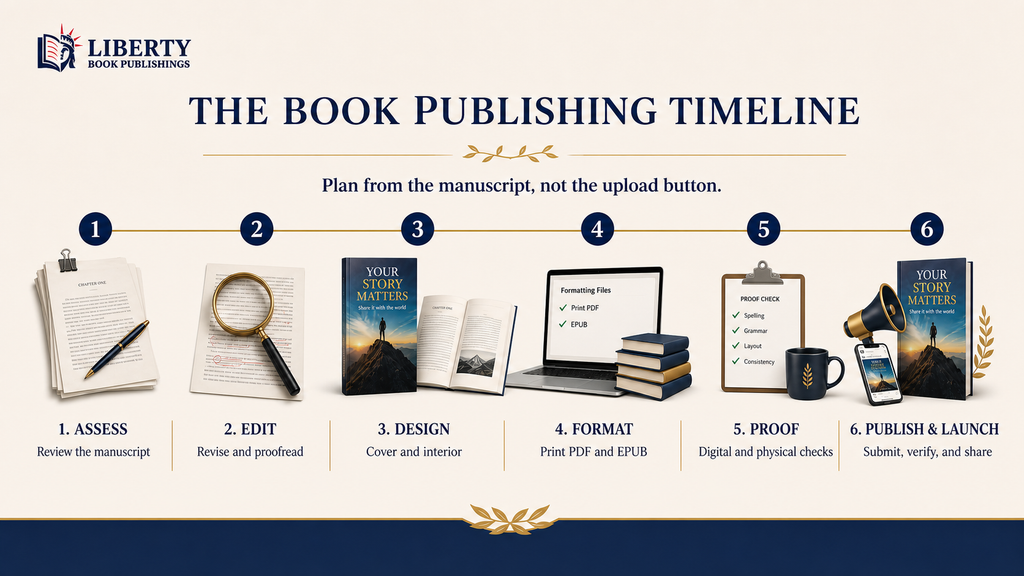
Infographic: A manuscript to launch schedule with approval gates and tasks that can overlap.
The same word count can hide very different jobs.
One manuscript may have gone through several author revisions, early readers, and a sound edit. Another may still have repeated chapters, missing evidence, unclear pacing, or a changing audience.
Before setting a date, answer four questions:
- Is the structure stable?
- Which editing stages are complete?
- Are permissions, citations, images, and contributor material ready?
- Which editions and distribution routes are required at launch?
If you cannot answer the first two, the schedule is still an estimate. Do not promise a public date based only on a finished first draft.
Timeline One: A Manuscript That Needs Major Revision
A book with structural problems should begin with assessment or developmental editing. The editor may recommend chapter changes, new material, cuts, a different order, or a clearer reader promise.
The editing report is only the start. The author needs time to revise. That part is hard to predict because it depends on the size of the changes and the author’s available hours.
After the revision, the manuscript may need a follow up review. Line or copyediting comes later. Proofreading follows once the wording is stable.
This route takes longer, but skipping the structural work does not remove the problem. It sends the problem into design, where changes become slower and more expensive.
Timeline Two: A Stable Manuscript That Needs Professional Editing
A stable draft can move into line or copyediting after an editor confirms the right service.
Time depends on word count, subject, complexity, and editor availability. The author also needs a review period. Accepting every change without reading it is not a sound shortcut.
Once the edit is resolved, a final proofread can catch missed errors and problems created during revision. The approved manuscript then moves into production.
This path is often easier to schedule because the book’s structure and content are settled.
Timeline Three: An Edited Manuscript Ready for Production
An edited and approved manuscript can move to cover design, interior design, and format planning.
Even here, allow time for decisions. Trim size, edition types, images, front matter, back matter, and design direction must be confirmed. The first layout will need review. Corrections may change page count and the print cover.
The fastest safe route is not instant upload. It is a clear production process with limited late changes.
Stage 1: Manuscript Assessment
An assessment defines the work ahead. It may be a formal editorial review or a production check on an already edited manuscript.
The reviewer should look at structure, language, completeness, special elements, permissions, and format needs. The result should state the next editing stage and any issue that could affect design.
Time can be lost when a project begins with the wrong service. A proofread cannot repair a weak structure. A formatter should not be asked to redesign unfinished content.
Stage 2: Editing and Author Revision
Editing can include several levels. Developmental editing addresses the book as a whole. Line editing improves expression and flow. Copyediting checks language, consistency, and usage. Proofreading catches remaining errors in stable text.
The author review period belongs in the schedule. Plan time to answer queries, accept or reject changes, fill gaps, and return a clean file.
Set one document as the master. Edits spread across email, old files, and separate chapters create delays and missing changes.
Stage 3: Cover Direction and Interior Planning
Cover research can begin while the final edit is closing. The designer can review genre, audience, themes, visual references, and competing titles.
The full print wrap cannot be finalized until the interior page count is stable. The front concept may start earlier. Spine and back measurements must wait.
Interior planning includes trim size, typography, chapter style, image treatment, and special pages. A complex layout needs more time than a plain text novel.
Stage 4: Typesetting and eBook Conversion
The print edition uses fixed pages. The eBook often uses a reflowable layout that adapts to the reader’s device.
Both files need review. A print PDF must be checked for margins, page order, image quality, running heads, page numbers, and blank pages. An EPUB needs navigation, image, link, and device checks.
Late rewrites at this stage can affect page flow, index entries, and cover width. Limit changes to true corrections unless the team agrees to a new schedule.
Stage 5: Metadata and Publishing Setup
Metadata work can begin before final files are ready. The title, subtitle, contributor names, book description, categories, keywords, rights, price, and publication date should be consistent.
Account setup can also begin early. Confirm who owns the account, where payments go, who controls the ISBN, and who can update the book later.
Do not rush metadata because it looks administrative. Errors can follow the book across retailer pages and distributor records.
Stage 6: Digital Preview and Physical Proof
Digital preview should happen before the proof is ordered. It can catch file warnings, margin problems, image placement errors, and a mismatched cover.
A physical proof adds another layer. Review type size, contrast, paper feel, margins, spine position, image quality, and the full cover. Read the copyright page, table of contents, chapter openings, and final pages again.
Shipping time belongs in the plan. So does a second proof when corrections affect the layout or cover.
Stage 7: Platform Review
Platform review begins only after upload and submission. It is one small part of the timeline.
Amazon KDP’s current publishing timeline guidance says that many book submissions and updates can take up to three business days to go live. It gives a typical review window of 24 to 72 hours for eBooks and up to 72 hours for paperbacks and hardcovers. Some book types and page updates can take longer.
Those are KDP specific estimates, not a promise for every book or platform. They can change. Check the official page again before setting a public date.
Leave room for a rejected file, metadata warning, or needed correction. A launch planned for the minute a review window ends has no safety margin.
Stage 8: Launch Preparation
Launch work should begin before the book is live. The timing depends on the plan.
You may need an author page, website updates, email copy, social graphics, retailer links, sample chapters, a media kit, advance readers, events, or outreach.
Do not send final cover files or retailer links to partners until they are approved. Draft the material early, then add the confirmed assets.
Work That Can Overlap Safely
Good overlap shortens the schedule without creating rework.
During Final Editing
You can research cover direction, review platform choices, gather author bio material, list launch contacts, and plan metadata.
During Typesetting
You can finish the description, prepare launch copy, set up accounts, and build a proof checklist.
During Platform Review
You can test links, schedule owned content, brief event partners, and prepare reader support.
The work should share one approved source of truth for the title, subtitle, contributor names, description, cover, date, and links.
Work That Should Not Overlap
Some shortcuts create more delay than they save.
- Do not complete final formatting while major edits continue.
- Do not finish a print cover before the page count is stable.
- Do not build an index before the print layout is fixed.
- Do not order launch stock before proof approval.
- Do not announce a retailer link before the listing is correct.
- Do not submit several conflicting file versions to different platforms.
Working Toward a Fixed Release Date?
Liberty can help map editing, design, formatting, proofing, setup, and launch work around the date that matters to your project.
Plan Your Production ScheduleWhat Commonly Delays Publication?
The Editing Level Was Underestimated
A manuscript enters copyediting, then reveals a structural problem. The project must move backward before it can move forward.
Author Feedback Arrives Late
Every stage has an approval point. If review time is missing from the schedule, the plan is already incomplete.
New Content Appears During Layout
Added chapters, images, notes, or references can change the page count and cover dimensions.
Permissions Are Unresolved
Quotes, lyrics, photos, charts, and third party material may require review or permission. Start early.
Several People Edit Different Files
Conflicting versions lead to missing corrections. Use one named master file and a clear handoff rule.
The Proof Is Treated as a Formality
A rushed proof review can send visible errors into the final book. Use a checklist and review in more than one sitting.
The Launch Date Has No Contingency
Platform warnings, proof shipping, illness, or a needed correction can happen. A plan needs room to absorb them.
How to Work Backward From a Release Date
Start with the date readers must be able to buy the book. Then add an internal release date before it. This gives the listing and links time to settle.
Work backward through these gates:
- Public release.
- Retail links verified.
- Platform approval complete.
- Final files submitted.
- Physical proof approved.
- Corrections complete.
- Print and eBook files reviewed.
- Manuscript locked.
- Editing complete.
- Assessment and scope approved.
Add author review time to each handoff. Add shipping where a physical proof is needed. Then include contingency based on the cost of missing the date.
A book tied to a conference, course, anniversary, or media event needs more protection than a flexible evergreen release.
How to Publish Faster Without Lowering the Standard
Freeze Decisions Early
Approve the title, subtitle, formats, trim, and design direction before final production.
Give Complete Feedback
Collect comments into one review round. Conflicting messages from several stakeholders slow the work.
Use a Clear Master File
Name versions by date and stage. Record who can edit the master.
Prepare Metadata in Parallel
The description, author bio, categories, keywords, and account details do not need to wait for the final proof.
Limit the First Release Scope
If the audience allows it, release the main formats first and add a complex edition later. Do not create every possible format only to meet an arbitrary date.
Hire for the Bottleneck
Professional help is most useful where the author lacks skill or time. Liberty’s publishing services cover editing, design, formatting, publishing, distribution, and marketing support.
Frequently Asked Questions
An upload can happen quickly when final files and metadata are ready. Preparing a professional book takes longer. The manuscript’s condition, formats, proofing, and launch plan set the real timeline.
KDP currently gives review guidance that varies by format. Its official timeline page lists typical eBook review at 24 to 72 hours and print review at up to 72 hours. Check the live guidance before launch because timing can change.
It often can, especially when the author must revise the structure. Formatting time also grows with images, tables, notes, workbooks, indexes, and several editions.
Cover research and front concept work can start. The final print wrap should wait for a stable interior page count and confirmed print choices.
It is safer to keep the date private or flexible until the proof is approved. A public date can be announced when the remaining risks are understood.
Late content changes are a common cause. They can reopen editing, alter layout, change page count, and require a new cover file.
Build the Date Around the Work
A realistic publishing schedule is not slow for the sake of being careful. It is clear about dependencies.
Review the manuscript first. Give the author time to respond. Lock the text before final layout. Approve the proof before release. Treat platform review as the final gate, not the whole process.
When the schedule follows the work, the team can move quickly without hiding risk. The result is a date you can explain and a book you can stand behind.
Ready to Build a Realistic Publishing Timeline?
Discuss your manuscript, required formats, target date, and support needs with Liberty. The plan can be shaped around the work that remains.
Get a Free Publishing Consultation