


A great book deserves to be discovered. But putting a book on a retailer’s website does not automatically put it in front of the right readers.
For publishers, the real challenge begins after the manuscript is ready. Readers need to discover the book, understand why it matters, and have a clear reason to pick it up. That takes more than a single social media post or a short advertising campaign.
Publishers have many ways to build visibility. SEO can help people discover books through search, and social media can create conversations around authors and titles.
Email can bring readers back. Paid advertising can put a book in front of specific audiences, while content and media outreach can build trust.
The important part is knowing which options fit your goals.
This guide explains the main promotional options available to book publishers and shows how to choose a strategy based on your audience, genre, budget, timeline, and long-term publishing goals.
Book Marketing Strategy at a Glimpse
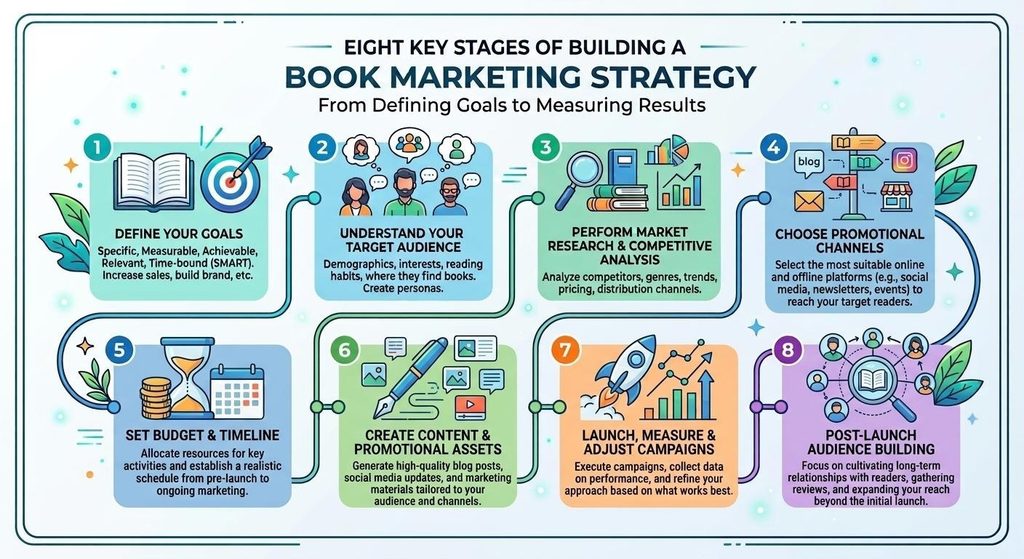
Infographic: The eight key stages of building a book marketing strategy, from defining goals to measuring results.
Every publisher’s situation is different, but a strong strategy usually follows these stages:
- Define the book’s purpose and marketing goals.
- Identify the target readers.
- Understand the book’s genre and market.
- Choose the most suitable promotional channels.
- Set a realistic budget and timeline.
- Create useful content and promotional assets.
- Launch, measure, and adjust campaigns.
- Continue building the audience after launch.
These steps can overlap, but the order helps prevent wasted effort.
For example, choosing advertising platforms before knowing who the book is for can lead to poor targeting. Creating social media content without a clear message can make a campaign feel scattered. Spending heavily before testing an audience can also make it harder to understand what is actually working.
Consider book marketing as a connected system, not just a collection of random promotional tasks.
1. Define What You Want the Book to Achieve
Before choosing marketing services, start with the goal.
A publisher promoting a debut novel may want to build awareness and generate early sales. A publisher with an established author may focus on keeping an existing audience engaged. A business publisher might use a book to strengthen an author’s professional reputation and generate leads.
Ask a few simple questions:
- What should this campaign accomplish?
- Who needs to discover the book?
- Is the main goal sales, awareness, audience growth, or author visibility?
- How will you know the campaign is working?
- What does success look like after three, six, or twelve months?
Your answers will shape almost every later decision.
A campaign designed to increase direct book sales may need stronger advertising and conversion-focused pages. A campaign focused on long-term discovery may place more weight on SEO, content, and audience building.
Do not choose a channel simply because other publishers are using it. Choose it because it supports a clear goal.
2. Understand the Readers You Want to Reach
The best promotion starts with knowing the reader.
“People who like books” is too broad to guide a useful campaign. A publisher should understand the specific group most likely to care about the title.
Consider:
- Age and demographics
- Interests and hobbies
- Problems or needs
- Favorite online platforms
- Search behavior
- Buying habits
- Related authors and books they already follow
Imagine you are promoting a beginner’s personal finance book. The ideal reader might be a young professional who wants to manage money better but feels overwhelmed by complicated financial advice.
That information can influence the language used in ads, the topics covered in blog posts, the social platforms selected, and even the type of partnerships pursued.
The clearer the audience, the easier it becomes to create a message that feels personal rather than generic.
3. Match the Strategy to the Book Genre
A marketing strategy should fit the book.
Different genres attract readers in different ways. A romance novel may depend heavily on reader communities, reviews, social content, and author branding.
A children’s book may require reaching parents, librarians, teachers, and gift buyers. Publishers working in this space can also explore our guide on how to publish a children’s book for a closer look at the publishing process.
A business book may perform well through professional networks, podcasts, search content, and industry publications.
Before choosing a promotional channel, ask:
Where does this book’s audience already spend time?
That question is often more useful than asking which platform is currently popular.
The genre can also influence the type of content you create. A cookbook might benefit from recipes and food-related videos.
Educational articles or short historical facts could support a history book. A self-help title might use practical tips that demonstrate the book’s value.
The book itself should guide the strategy.
4. Choose the Right Marketing Services for Your Goals
Once the audience and goals are clear, you can evaluate the different options available to publishers.
Website and Landing Page Promotion
A publisher’s website can become the central home for a book campaign. It can provide the book description, reviews, sample content, author info, purchasing options, and links to relevant retailers.
A dedicated landing page can also be useful during a launch. Instead of sending every visitor to a general homepage, publishers can direct interested readers to one focused page designed around a particular title.
The page should load quickly, work well on mobile devices, and make the next step clear.
Search Engine Optimization
SEO helps publishers attract people who are already searching for relevant topics, authors, genres, or solutions.
For example, someone searching for “best books for first-time entrepreneurs” may already be interested in business books. A publisher that creates genuinely useful content around this topic has an opportunity to introduce its relevant titles.
SEO can involve:
- Keyword research
- Helpful blog content
- Optimized book pages
- Internal linking
- Technical website improvements
- Author and genre pages
One advantage of SEO is that useful content can continue attracting visitors after the original campaign ends.
Social Media
Social media gives publishers a way to build attention and conversation around books.
Instead of posting only “Buy this book,” publishers can share:
- Author interviews
- Behind-the-scenes content
- Short videos
- Reader questions
- Book recommendations
- Quotes and excerpts where permitted
- New release announcements
- Relevant educational or entertaining content
The goal is to give people a reason to follow and interact with the publisher or author, not simply ask them to purchase something.
Paid Advertising
Paid advertising can help publishers reach specific audiences and test messages quickly.
Search ads can reach people actively looking for a topic. Social ads can target people based on interests and other available audience signals. Retailer advertising can place books in front of people browsing related titles.
Paid ads should be treated as a testing process rather than a guaranteed sales machine.
Start with a defined audience and a manageable budget. Test different messages and creative assets, then use the results to guide future spending.
Email Marketing
An email list gives publishers a direct connection with interested readers.
Newsletters can announce new releases, share author updates, recommend related books, provide useful content, and offer appropriate promotions.
Email is especially valuable because one reader can remain connected with a publisher beyond a single book. Someone who enjoys one title may become interested in another title from the same author, series, genre, or publishing list.
The focus should be on building a useful relationship rather than sending constant sales messages.
Content Marketing
Content can help publishers attract readers before asking them to buy.
A publisher could create:
- Blog articles
- Author interviews
- Videos
- Podcasts
- Reading guides
- Educational articles
- Book-related resources
Let’s assume a publisher is promoting a leadership book could also publish practical articles about handling difficult conversations, managing teams, or improving workplace communication.
This content can then be shared through search, social media, email, and other channels.
Influencer and Media Outreach
Book reviewers, bloggers, podcasters, journalists, and online creators can introduce titles to audiences that already care about books or related subjects.
The key is relevance.
A publisher should not choose a creator simply because they have a large following. A smaller creator with an audience that strongly matches the book may be more useful.
Outreach should also be professional and honest. Reviews and endorsements should follow the policies of the relevant platform and clearly disclose relationships where required.
Not Sure Which Marketing Approach Fits Your Book?
Choosing the right channels can be easier with a clear plan. Get professional guidance based on your book, audience, goals, and budget.
Talk to a Marketing Expert5. Build a Strategy Around Your Budget
Not every publisher has the same resources. A new independent publisher may have a very different budget from an established publishing house.
That does not mean a smaller budget cannot produce useful results. It means priorities matter.
Book format can also affect production costs, pricing, and how you position a title. If you’re deciding between formats, our guide to hardcover vs. paperback can help you understand the key differences.
Instead of trying to do everything, identify the activities most likely to reach the target audience.
For example, a publisher with a limited budget might focus on:
- A strong book page and website.
- Consistent organic content.
- An email list.
- A small paid advertising test.
- Relevant reviewer or creator outreach.
The goal is not to spend the most. It is to spend intelligently.
Leave part of the budget available for testing. Early results can show which channels deserve more attention.
6. Plan Marketing Around the Book’s Timeline
Promotion should not necessarily begin on publication day.
A simple campaign can have three stages.
Pre-Launch
Build awareness and prepare the audience. This may include author content, email announcements, advance copies, interviews, or early promotional materials.
Launch
Increase visibility and make it easy for interested readers to purchase or learn more. Coordinate website updates, social posts, advertising, email communication, and relevant outreach.
Post-Launch
Continue finding new readers. Refresh content, promote reviews where appropriate, test new advertising ideas, participate in relevant events, and keep the author or publisher visible.
This approach gives the book more than one opportunity to reach readers.
7. Measure What Is Actually Working
Marketing decisions should be based on evidence whenever possible.
The right measurements depend on the goal. Useful metrics can include:
- Website traffic
- Email subscribers
- Email engagement
- Social engagement
- Advertising clicks
- Conversion rates
- Book sales
- Revenue
- Cost per acquisition
- Downloads or registrations
Do not assume that the biggest number is always the most important.
For example, 10,000 website visitors may sound impressive, but 500 highly interested visitors could be more valuable if they take meaningful actions.
Review performance regularly and look for patterns. If a certain topic consistently attracts the right readers, create more content around it. If an advertising audience produces clicks but no sales, investigate the message, landing page, offer, or targeting.
Marketing improves when publishers learn from what happens.
8. Decide Whether You Need One Service or a Full Strategy
Some publishers only need help with one area. Others benefit from a broader plan.
A publisher with a strong internal marketing team might only need specialist SEO support. Another may need help with strategy, content, advertising, social media, and campaign management.
There is no requirement to outsource everything.
When evaluating marketing services, look at what your team can handle well and where outside expertise would create the most value.
An integrated strategy can be powerful because the channels support one another. Social content can encourage email sign-ups. Email can support a launch. Paid ads can bring new people into the campaign.
The goal is coordination, not simply having more channels.
Ready to Build Your Book Marketing Plan?
Turn your publishing goals into a clear marketing strategy designed to reach the right readers and build long-term visibility.
Create Your Publishing Marketing StrategyCommon Mistakes Book Publishers Should Avoid
Even a strong marketing plan can fall short when publishers overlook a few common mistakes. Avoiding these issues can help keep your strategy focused and effective.
- Trying to Reach Everyone: A broad audience can make messaging weak. Define the readers who are most likely to care about the book.
- Copying Competitors: Competitor research can reveal useful ideas, but copying another publisher’s campaign rarely creates a strong identity. Learn from competitors without losing your own voice.
- Using Too Many Platforms: A publisher does not need to be everywhere. Focus on channels where the intended audience is actually active.
- Expecting Instant Results: Some channels, especially paid advertising, can produce data quickly. Others, such as SEO and audience building, often require more time.
- Ignoring the Book’s Positioning: Even excellent promotion becomes harder when the book’s title, cover, description, or audience positioning is unclear. Marketing cannot completely fix a product that is difficult to understand.
- Failing to Track Results: Without measurement, it is difficult to know whether an activity is worth continuing. Set clear goals before launching a campaign.
Questions to Ask Before Hiring a Book Marketing Provider
Before choosing a provider, ask questions that help you understand exactly what you are getting.
Consider asking:
- Have you worked with publishers or authors before?
- Do you understand this book’s genre and audience?
- Which channels would you recommend?
- Why do you recommend those channels?
- What will you measure?
- How often will reporting happen?
- Who creates the content?
- Who manages advertising accounts?
- What happens if a campaign does not perform as expected?
- What is included in the agreement?
A trustworthy provider should explain the strategy clearly and avoid promises that sound too good to be true.
Be especially careful with anyone promising guaranteed sales, rankings, bestseller status, or a specific number of positive reviews.
How to Build a Marketing Strategy That Grows with Your Publishing Business
A strong strategy should become more useful over time.
Every campaign produces information. You learn which readers respond, which messages attract attention, which content performs well, and which channels generate meaningful results.
Keep those lessons.
Over time, publishers can build valuable assets such as:
- A growing email list
- Search-friendly website content
- Reader communities
- Author audiences
- Reusable promotional materials
- Better customer insights
- A recognizable publishing brand
For publishers working with authors who need help developing their manuscripts, book ghostwriting services can also support the content-development stage before a title moves into promotion.
These assets can support future releases instead of starting from zero every time a new book launches.
This is where marketing services can become part of a broader publishing system rather than a one-time promotional expense.
A Simple Book Marketing Strategy Checklist
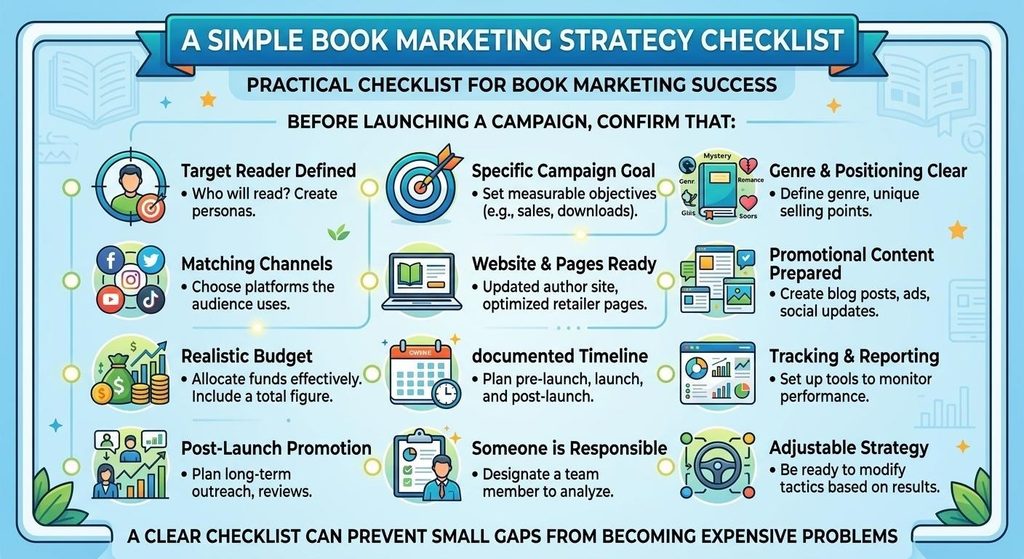
Infographic: A practical checklist for choosing and managing a book marketing strategy.
Before launching a campaign, confirm that:
- The target reader is clearly defined.
- The campaign has a specific goal.
- The book’s genre and positioning are clear.
- The chosen channels match the audience.
- The website and book pages are ready.
- Promotional content is prepared.
- The budget is realistic.
- The launch timeline is documented.
- Tracking and reporting are in place.
- The strategy includes post-launch promotion.
- Someone is responsible for reviewing performance.
- The campaign can be adjusted based on results.
A clear checklist can prevent small gaps from becoming expensive problems.
Need Help Choosing the Right Publishing Marketing Strategy?
If you are unsure where to begin, professional guidance can help you evaluate your options, identify priorities, and create a practical plan instead of spending money on disconnected tactics.
Talk to a Publishing Marketing ExpertFinal Thoughts on Marketing for Book Publishers
The right strategy starts with the reader and the book, not with a list of popular platforms.
Understand who you want to reach and define what you actually want to achieve. Choose channels that fit the audience, track what happens, and set a realistic budget. Then use those results to improve the next campaign.
Some books may need strong SEO and content. Others may benefit more from social communities, email, advertising, media outreach, or a combination of several channels.
There is no one-size-fits-all answer. The best approach is a focused strategy that helps the right readers discover the right books and gives publishers a clear way to measure and improve their efforts.
Frequently Asked Questions
Book marketing services can include SEO, social media promotion, paid advertising, email marketing, content creation, website promotion, influencer outreach, media relations, and campaign strategy. The exact mix depends on the book, target audience, goals, budget, and publishing timeline.
Start by defining your goal and identifying your ideal readers. Then consider the book’s genre, audience behavior, budget, and timeline. Choose the channels most likely to reach your readers and support your goal rather than trying to use every available option.
There is no single best option for every publisher. SEO, content marketing, email, social media, paid advertising, and media outreach can all be useful. The strongest approach is usually a focused combination of services that matches the publisher’s audience, book genre, and marketing goals.
Costs vary based on the type and number of services, campaign length, audience size, competition, and level of professional support required. Some publishers may only need help with one area, while others may invest in a complete campaign. A clear, itemized proposal is the best way to understand the expected cost.
They can help increase book sales by improving visibility, reaching relevant readers, building trust, and making it easier for people to discover and purchase a book. However, no legitimate provider can guarantee a specific number of sales because results also depend on factors such as the book, price, audience demand, reviews, competition, and distribution.
Ideally, marketing should begin before the book is released. Pre-launch activity can build awareness and prepare readers, while launch campaigns can create momentum. Promotion should also continue after publication to help the book reach new readers over time.
Hiring an agency can be useful when a publisher lacks the time, experience, or internal resources to manage promotion. An agency may also provide specialized skills in areas such as SEO, advertising, content, or audience growth. Before hiring one, check its experience, services, reporting process, and approach to measuring results.
Publishers can reach more readers by clearly defining their target audience and promoting books through channels those readers actually use. SEO, useful content, media outreach, email, social media, paid advertising, book communities, events, and relevant partnerships can all help expand reach.
Success should be measured against the campaign’s goal. Useful metrics can include website traffic, email sign-ups, engagement, advertising clicks, conversion rates, book sales, revenue, and cost per acquisition. Looking at these numbers together helps publishers understand what is working and where the strategy needs improvement.